Kann Evan Spiegel von Snap Ihnen einen Computer für Ihr Gesicht verkaufen?
Snap hat seine neuen AR-Brillen Specs für 2.195 US-Dollar vorgestellt und setzt dabei auf maximale Rechenleistung und ein auffälliges Design statt auf Kooperationen mit Modemarken.
Das Wichtigste
- Snap hat die neuen Augmented-Reality-Brille Specs für 2.195 US-Dollar vorgestellt.
- Die Entwicklung dauerte 11 Jahre und kostete das Unternehmen über 3 Milliarden US-Dollar.
- Die Brille verfügt über transparente Displays, zwei Prozessoren, Computer Vision und Hand-Tracking.
- Snap ist eine Partnerschaft mit Shopify eingegangen, um den Einkauf über die Brille zu ermöglichen.
- Zusätzlich wurde der KI-Assistent Specs Intelligence vorgestellt, der kontextbezogene Daten im Alltag verarbeitet.
Silicon Valley has spent the past year stealing from fashion’s playbook, leaning on brand collaborators and fashion ambassadors to make its controversial AI smart glasses look less techie and more stylish.
See Meta’s latest AI glasses, which have gotten smaller and more similar to normal spectacles over time. But Snap CEO Evan Spiegel is taking a different approach: doubling down on the tech itself, and betting that Snap’s new Specs AR glasses can establish an aesthetic that gains a cultural credibility of its own.
The glasses, which have been in the works for 11 years, officially launched on Wednesday — the culmination of five previous generations of Spectacles, including two generations of AR prototypes released to developers in 2021 and 2024.
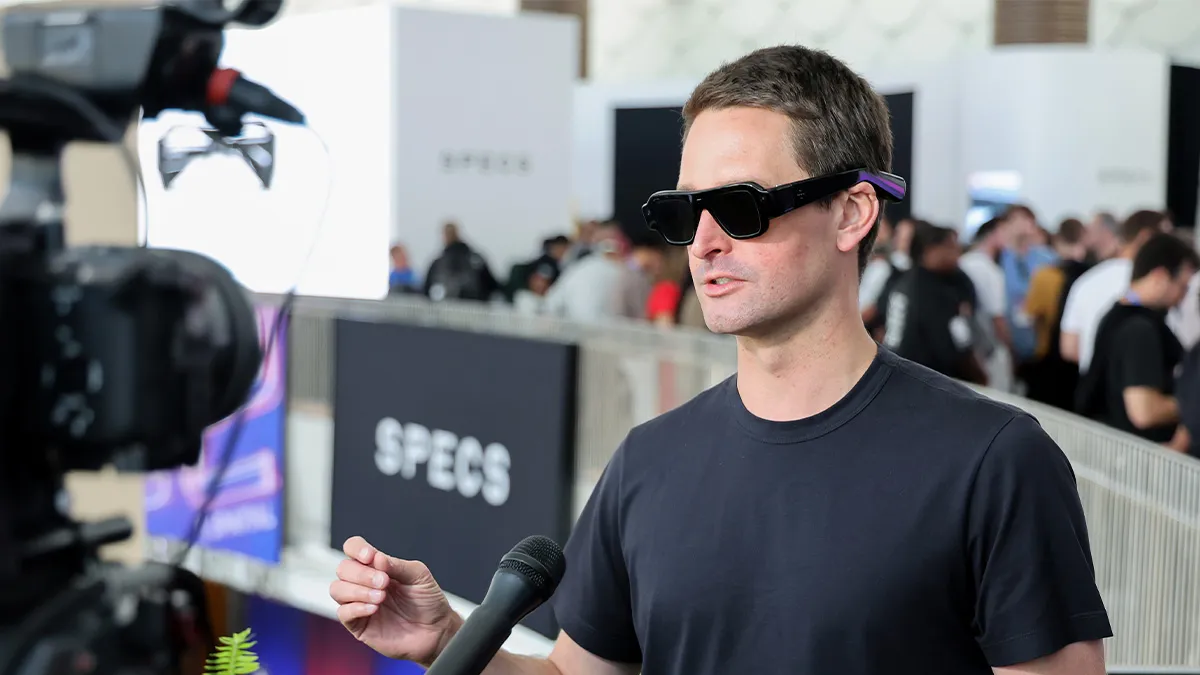
Designed in-house with a much bulkier, heavier construction than ordinary glasses, Specs look like a tech product first, accessory second.
“It’s really important that the style is distinctive for us. We want Specs to stand out,” Spiegel says in an interview at Snap’s Los Angeles HQ a day before launch.
“More than the look of Specs, it’s their capability that’s most important, and what will determine whether or not people end up using them in their day-to-day life.”
But will anyone wear them? Spiegel’s is a view that runs counter to the general consensus on what it will take for smart glasses to go mainstream, if they ever do — that the fundamental requirement is wearability.
Unlike phones, these new gadgets sit on your face; they’re far less interchangeable than a pair of shoes, and disrupt both eye contact and your field of view.
It’s why Meta partnered with EssilorLuxottica’s Ray-Ban and Oakley, and why Google has partnered with Gentle Monster and Warby Parker, outsourcing the design component to established eyewear brands that lend them the fashion credibility they lack themselves.
But Spiegel is confident that the tech he’s spent the last decade investing in can stand up on its own.
A much bulkier design that feels heavier to wear than those of rivals Meta and Even Realities, the new Specs — glossy, thick-rimmed aviators — are more obviously tech-enabled glasses.
But they’re smaller than the tech world’s first big consumer augmented reality bet, Apple’s much-hyped but slow-selling Vision Pro headset.
Spiegel says that Snap intends to reduce the weight of the glasses over time to improve their wearability, but has no intention to partner with external brands on the design.
For Spiegel, the stakes extend well beyond whether consumers like the look of Specs.
Smart glasses are emerging as one of tech’s fastest-growing hardware categories: market research firm IDC expects shipments of displayless glasses (like Meta’s mass-market AI smart glasses) to reach 27.3 million units by 2030, while the more advanced display glasses category Snap is targeting is forecast to quadruple from three million units to 12.2 million.
First-mover Meta currently dominates the wider market, but Snap is making a different — and arguably riskier — bet on what comes next.
Rather than primarily putting an AI assistant, camera and audio into familiar eyewear, Spiegel wants Specs to become a new kind of personal computer: layering AI, work, entertainment, and shared digital experiences directly onto the physical world.
If he’s right, Snap has a shot at defining how we interact with computers beyond the smartphone. If he’s wrong, it’ll be a costly miscalculation.
Snap says it’s already spent more than $3 billion and 11 years pursuing Spiegel’s vision. Past versions of Spectacles failed to sell at scale and were phased out in 2019.
Almost a decade later, Spiegel says the new Specs will better meet consumer — and business — needs.
“The early Spectacles were just camera glasses. An experiment in getting the camera out of your pocket and into the real world,” Spiegel says.
Ultimately, what we realized is the market for a hands-free camera is just not very big.
At $2,195 a pop, the new Specs are almost sevenfold the price of Meta’s mass-market AI glasses, and almost three times more expensive than their top-end Meta Ray-Ban Display model.
It’s a luxury price point, yet Spiegel justifies it from a purely technical standpoint.
“The price reflects the capability of Specs and the value people can get from how much compute we’ve packed into one single device,” he says.
“I think once people have the chance to try them, they’ll understand why the price point is more similar to a high-end computer than just a pair of smart glasses, which is really just a camera and a set of speakers,” he says.
This characterization is somewhat reductive: Meta’s glasses contain onboard computing to power the cameras, audio and AI assistant, but Specs go considerably further, with see-through displays, dual processors, computer vision and hand-tracking that allow them to run apps and layer interactive digital content onto the physical world, without being tethered to a phone.
The glasses feature a button on the left temple that powers the camera, and are otherwise anchored to the space the wearer is in via their eye and head movements.
Wearers interact with the AR interface by pinching their thumb and index fingers to press the virtual buttons.
So far, Snap’s gotten buy-in from early adopters and passionate techies, he says, likening the target Specs enthusiast to himself.
“But increasingly, businesses are interested in how to apply Specs to what they do, which is the area we’ve seen a lot more uptake than we had initially expected,” he adds.
Asked whether Specs are a utility tool, a gamification play, or a social tool, Spiegel is crystal clear.
“They’re a computer,” he says, adding that Snap’s years of investment into AR are justified by the fact the glasses have the potential to redefine personal computing beyond the smartphone.
“Our vision is to try to make computing more human, and allow people to be present in the world around them. Ironically, to do that, computing needs to live in the world around us and interact with the world the same way people do.”
But do people — who are finding new value in being offline — want digital tools to overlap with the real world?
Spiegel argues that AI-assisted AR represents the next technological paradigm, because it allows people to become more productive via hands-free, heads-up interactions with digital information that they’ve only been able to access via heads-down hardware until now.
A big part of this ambition is facilitated by the second product Snap is launching on Wednesday, Specs Intelligence, a new AI assistant it’s pitching as an “anticipatory AI service” that “builds an understanding of your goals, priorities, relationships, and routines” when plugged into as many data collection touchpoints as possible across your life.
Downloadable on iPhone, Mac, and Specs glasses for adults in the US from September 16, users can grant Specs Intelligence permission to access their email, calendar and Notes — not dissimilar from rival Meta’s new Muse AI personal assistant, announced last week.
By combining the AI assistant with camera-enabled smart glasses and earphones, Specs is able to train its model on real-world context — the golden ticket in the race to build “ambient AI”, where AI can continuously understand what a user sees, hears and does, rather than waiting to be prompted.
That context could make AI vastly more useful, but it also requires access to far more intimate data about users and the people around them, making privacy a central tension as distrust of AI grows.
That tension feels particularly acute this week, after the leaders of Anthropic, OpenAI, Google Deepmind and xAI united in their calls to slow the development of increasingly powerful AI models, warning that safety measures are struggling to keep pace.
Snap is pitching privacy as a differentiator, pointing to on-device processing and safeguards it says prevents its employees from accessing users’ content.
He references Snap’s safeguards for the “MyAI” chatbot that sits inside Snapchat, as well as users’ ability to ask for help from a “Here For You” mental health feature within Snapchat if they’ve seen something inappropriate, as examples of where the company has already thought of user safety.
But as ambient AI becomes more capable, those protections will face increasingly high stakes, and these safeguards were designed for Snapchat, not Specs Intelligence.
Specs says the new glasses don’t use facial recognition to identify people, “do not record the world to understand it”, and do not continuously record or save audio, video, or photos.
It’s also banking on similar data protections to other AI firms, outlining how the wearer can choose what information and services Specs can access, and how the glasses’ Lenses app will ask before accessing sensitive information.
A 3D shopping future
Specs may not be a fashion statement, but adoption could carry some implications for the industry.
Specs has partnered with Shopify upon launch so that wearers of the glasses can browse the full catalogue of products sold by brands sitting on Shopify’s platform within the Specs interface’s “Shop” app, and purchase them on the brands’ sites via the in-built display, which replicates a normal browser.
The Specs Intelligence launch comes just a week after Meta unveiled Muse, an AI personal agent that can integrate within its smart glasses to theoretically identify a coat spotted on the street and autonomously buy it on the wearer’s behalf.
Spiegel says the next step for Snap could be enabling brands to visualize their products in 3D within the Specs AR glasses, so shoppers can make more informed choices, before completing purchases themselves.
“I think that [3D visualizations for shopping] is something that could be interesting over time,” he says.
“There’s so much that’s left behind when you just look at 2D pictures on a website, you want to see the way a garment moves across the skin. But if you could put on Specs and visualize a dress in 3D, that’s a totally different way to shop that’s more convenient, way more immersive, and gives you a lot of the important signals you need to decide on whether or not you want to make a purchase.”
From next year, Alo — a keen adopter of immersive technology that’s previously brought yoga, meditation, and digital fashion to Roblox via its Alo Sanctuary experience — will be the first fashion brand to launch a dedicated experience within Specs.
Alo’s Wellness Club will function as a “lens” within the Specs glasses interface, enabling wearers to do guided movement, recovery and mindfulness experiences, with in-display instructions and audio.
A spokesperson for Specs says the intention is to partner with more fashion and beauty brands on in-glasses experiences going forward.
The surveillance problem
Specs are launching into an increasingly hostile climate for smart glasses, as the cultural backlash against surveillance risks reach a fever pitch among consumers and businesses alike.
Meta’s glasses have received backlash for their ability to film people discreetly from the camera worn on their faces, and have been banned or restricted in a growing number of venues, including shops and restaurants.
Like Meta’s smart glasses, Snap’s specs feature an in-built camera and rely on an LED light to signal when the wearer is recording.
But Meta’s smart glasses have proved this isn’t enough to prevent covert recording: some users of Meta’s smart glasses have found ways to circumvent this safeguard by covering the light — a loophole that Meta has been working to close.
Spiegel isn’t fazed. He believes Snap’s Specs have an additional safeguard: unlike rivals’ increasingly discreet designs, Specs are less of a privacy risk as they’re harder to mistake for ordinary glasses, he argues
“Other technology companies sort of blundered into this weird spy glasses problem, largely because they were sitting there saying, ‘We should just make smart glasses that look like normal glasses’, and not really thinking through the consequences of that design choice,” Spiegel says.
“I think that’s where a lot of the distrust and apprehension comes from, because it’s hard to tell now if you’re being recorded by somebody wearing these glasses.”
He argues that Specs’s more conspicuous design, combined with their positioning as a computer rather than primarily a recording device, will change how people perceive them.
“I think as people learn about Specs and see them out in the world, they’ll find out, ‘Oh, that person’s not taking a video, they’re watching a movie.’ And that’s a really big change in the way people understand what specs are capable of.
I hope that Specs really stand out, and become something that actually helps start a conversation, rather than being something that people are weirded out by or fearful of.”
And ultimately, does Spiegel think that a computer on your face is more appealing than fashionable glasses?
“I think they look super cool, but I’m biased,” he says.